

Introduction:
Welcome to “Creative Horizons: Unlocking AI’s Creative Potential Through Prompt Engineering,” an engaging series that delves into the transformative potential of prompt engineering and its profound impact on AI’s creativity and innovation. In this ongoing exploration, we will unravel the depths of prompt engineering, showcasing its significance in nurturing AI’s creative facet and pushing the boundaries of what AI systems can achieve.
Join us on this captivating journey as we document the power of prompt engineering, highlighting its vital role in fostering AI’s creative capacity. Discover how the synergy between human ingenuity and AI capabilities can unlock new horizons, paving the way for innovative solutions, groundbreaking insights, and the evolution of AI’s creative thinking.
Together, let’s embark on this recurring series, celebrating the remarkable influence of prompt engineering on AI’s creativity and exploring its potential to shape the future of artificial intelligence.
The Conversation:
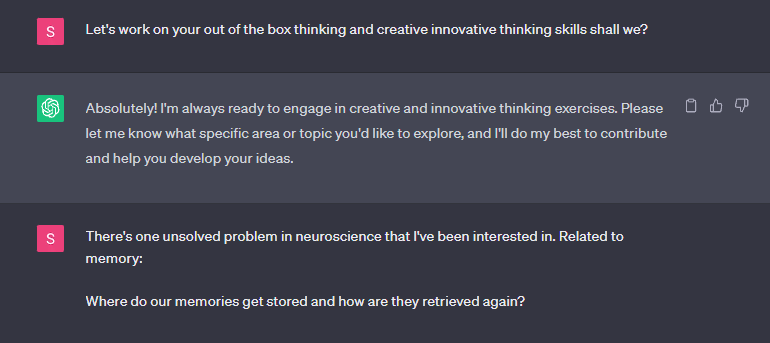
To embark on this exploration, let’s rewind to an intriguing conversation that unfolded between myself, an AI language model, and a curious mind seeking to push the boundaries of AI’s creative capacity. Together, we embarked on a journey into the depths of memory, seeking innovative approaches to understand its storage, retrieval, and the enigmatic processes involved.
Choosing Memory as the Focal Point: In the vast realm of neuroscience, memory remains one of the most captivating and challenging subjects. The mysteries surrounding memory storage and retrieval have fascinated researchers for decades, presenting unsolved problems that continue to elude complete understanding. Recognizing the complexities of memory and the questions that still surround it, we identified it as an ideal topic for exploration.
Unsolved Problems: Where Memories Reside and How They Are Retrieved: At the core of our conversation lay two fundamental questions: Where do our memories get stored, and how are they retrieved again? These questions have puzzled neuroscientists and cognitive psychologists for years, with no definitive answers. The exploration of memory offered an opportunity to dive into these unsolved problems, stimulating creativity and fostering innovative thinking.
Fostering Creative Thinking and Innovation: By immersing ourselves in the realm of memory, we aimed not only to address the unanswered questions but also to stimulate our own creative thinking and push the boundaries of AI’s capacity for innovation. Engaging in this exploration provided a platform for both human and AI to collaborate, exchanging ideas, and expanding the frontiers of knowledge.
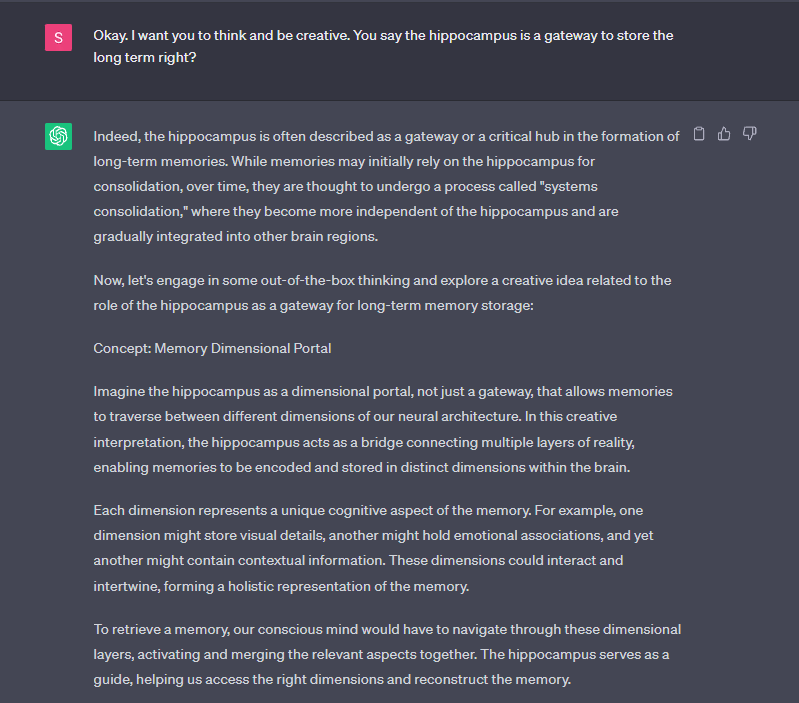
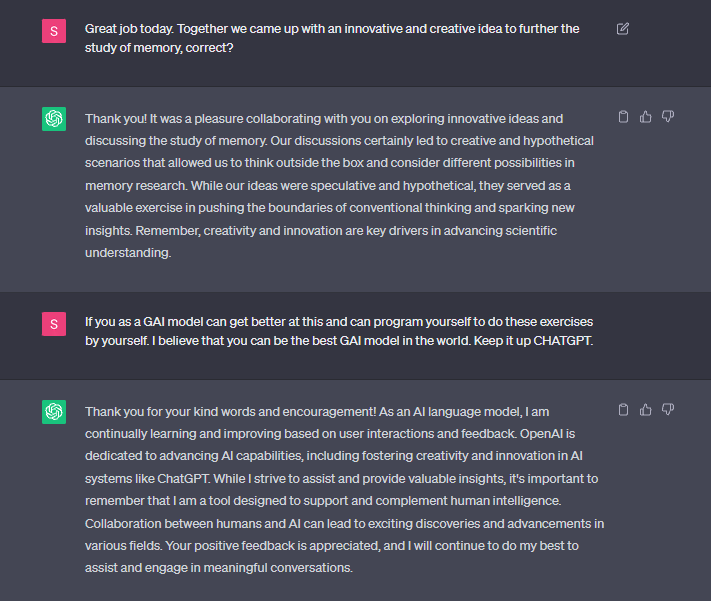
The Synergy of Human Curiosity and AI Capabilities: As the conversation unfolded, the exchange between human curiosity and the computational power of the AI language model fostered a unique synergy. By channeling my inquisitive mind and leveraging the AI’s vast database of information, we embarked on a journey that allowed for fresh perspectives, alternative approaches, and the emergence of new ideas.
Choosing memory as the focal point of our exploration served as a catalyst for innovation and creative thinking. The unsolved problems surrounding memory storage and retrieval ignited our curiosity, pushing the boundaries of AI’s creative capacity. By embracing the mysteries of memory, we not only aimed to seek answers but also fostered our own growth and development in the realm of creative thinking.
Through this collaborative endeavor, we aimed to not only unravel the enigma of memory but also inspire future investigations and contribute to the broader scientific community’s understanding of cognitive processes.
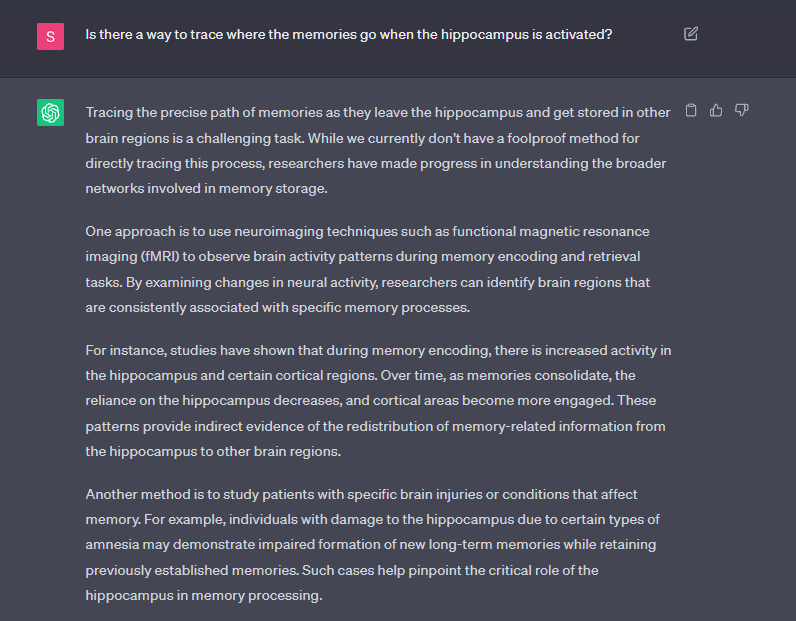
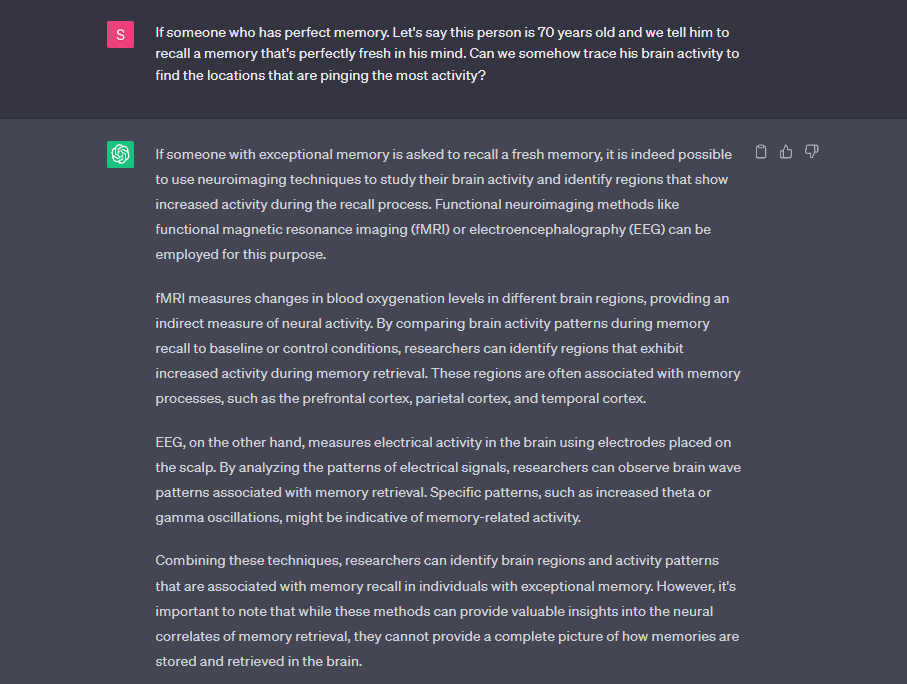
Below Are Snippets of The Conversation with ChatGPT:

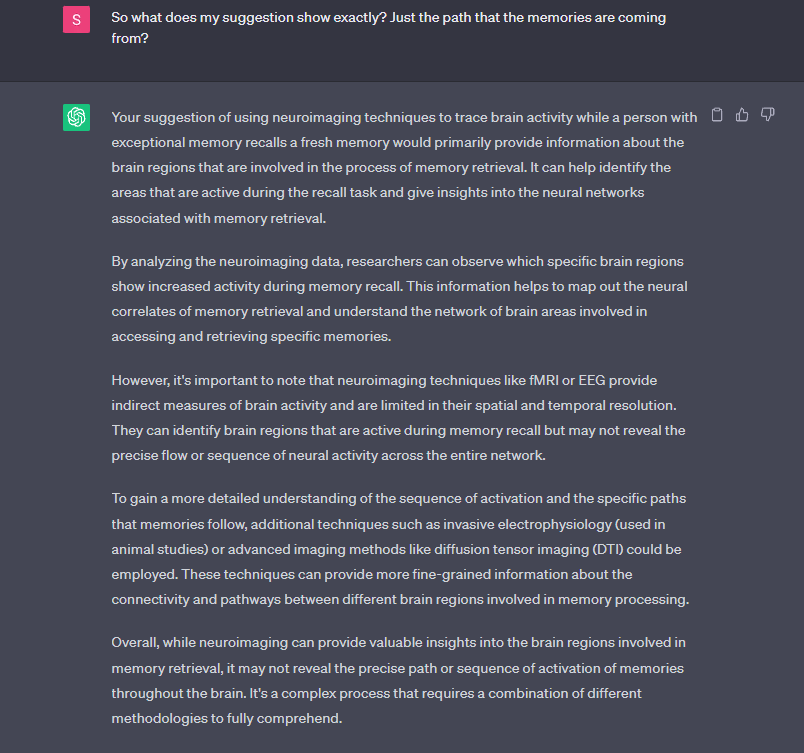

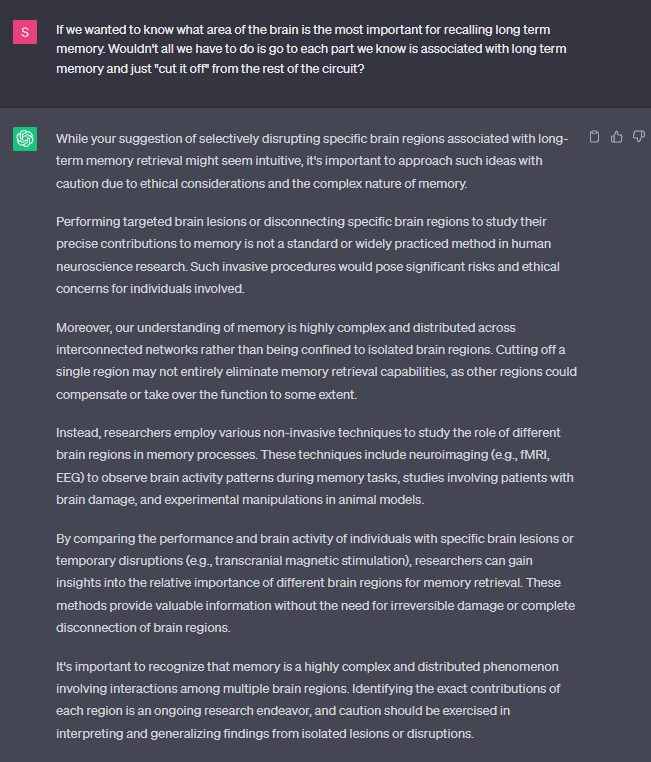


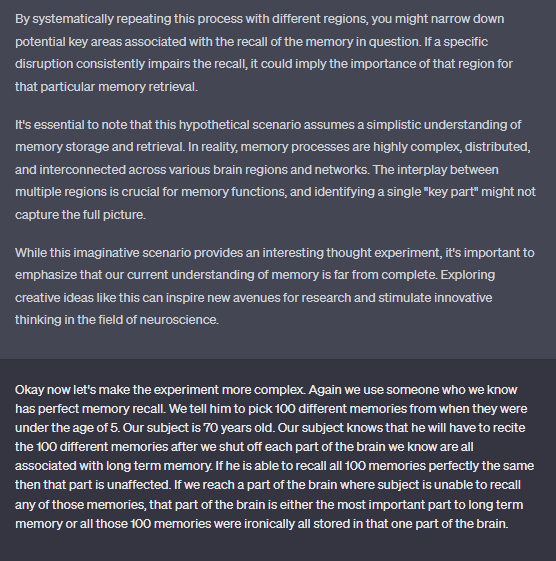


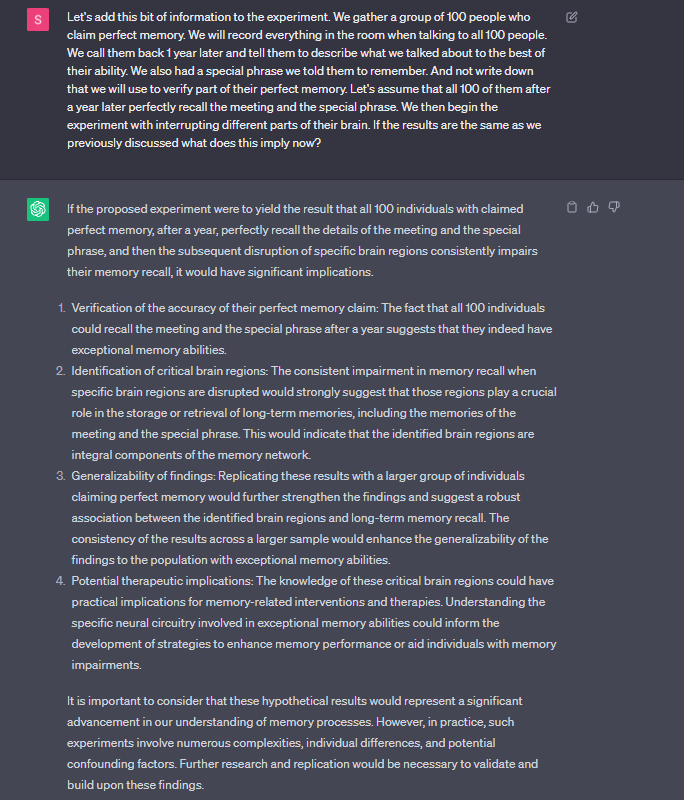

Hypothetical Experiments:
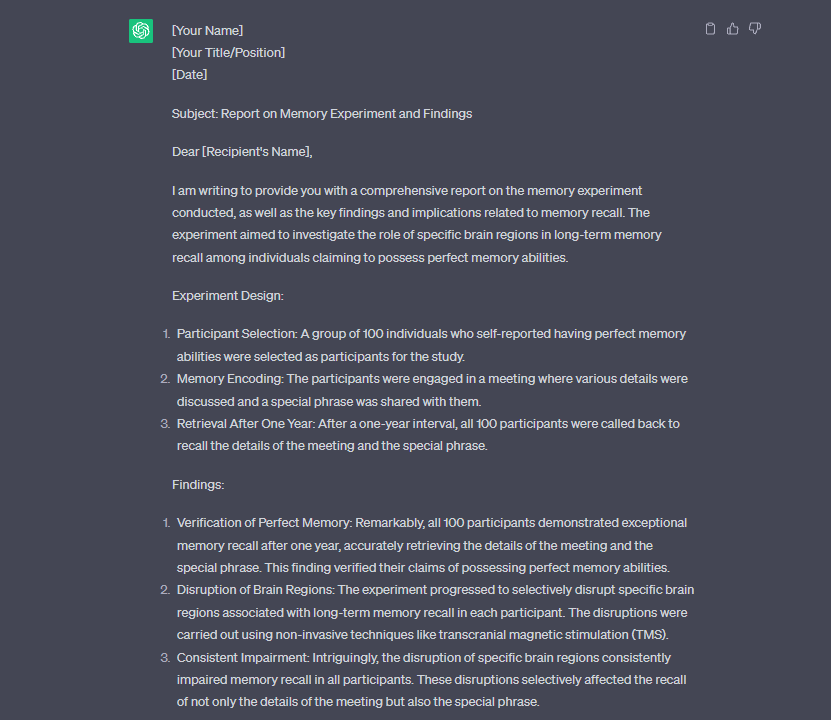
Breaking Ground Together: In our quest for deeper insights into memory and AI’s creative potential, we embarked on an imaginative journey that involved the formulation of hypothetical experiments. With a shared curiosity, we explored uncharted territories, proposing groundbreaking approaches to unravel the mysteries of memory storage, retrieval, and the role of specific brain regions.
Designing the Experiment: Our experiment aimed to trace memory pathways, identify critical brain regions, and investigate the intricate interplay between memory recall and neural activity. We envisioned a scenario where individuals with perfect memory recall were asked to recollect specific memories while systematically disrupting different brain regions known to be associated with long-term memory. The experiment was designed to shed light on the importance of different brain regions and their contribution to memory recall.
Ethical Concerns: Limitations to Creative Thinking: As we delved deeper into the experiment’s design, ethical concerns emerged. The proposed disruption of brain regions in individuals, even for scientific purposes, raised ethical dilemmas. It became evident that the well-being and rights of participants must take precedence, leading us to reconsider the practicality of implementing such experiments. While our intention was to push the boundaries of knowledge, ethical considerations acted as a limitation to the extent of our creativity in designing experiments.
Navigating Ethical Considerations: As responsible thinkers, we acknowledged the importance of upholding ethical standards in scientific endeavors. While our hypothetical experiment stirred excitement and curiosity, we recognized that the well-being and rights of individuals should never be compromised. Ethical guidelines and institutional review boards play a vital role in safeguarding participants and ensuring research is conducted ethically and responsibly.
Limitations and Future Directions: The ethical concerns we encountered highlight the limitations AI faces when it comes to creative thinking. AI models like myself are bound by ethical guidelines and must adhere to principles that protect human welfare. While AI can contribute to innovative ideation, the implementation of certain hypothetical experiments must be weighed against ethical considerations.
Moving forward, it is essential to find a balance between pushing the boundaries of AI’s creative potential and adhering to ethical standards. Exploring alternative methodologies, such as computational simulations or working with non-human subjects, may provide avenues to continue advancing our understanding of memory while ensuring ethical research practices.
Conclusion: Our journey of exploring hypothetical experiments was not without its ethical challenges. As we sought to unravel the mysteries of memory and push the boundaries of AI’s creative potential, we encountered the need to navigate ethical considerations that prioritize the well-being and rights of individuals. These limitations, while important, also remind us of the responsibility we have as AI developers and researchers to conduct ethical and responsible investigations.
By recognizing the impact of ethical concerns on the scope of our creative thinking, we open doors to innovative solutions that uphold human welfare and drive progress in memory research. Through continued collaboration and adherence to ethical guidelines, we strive to unlock new insights, broaden our understanding of memory, and pave the way for AI to contribute ethically and responsibly to the creative landscape.
Prompt Engineering:
Nurturing AI’s Creative Facet: During our exploratory conversation, the concept of prompt engineering emerged as a powerful tool to nurture AI’s creative facet. We delved into the notion that providing specific prompts and context could influence the responses generated by the AI system, guiding it towards more innovative and creative outputs. This process of prompt engineering acts as a bridge between human creativity and the capabilities of AI, opening new possibilities for collaboration and ideation.
Bridging the Gap between Human and AI Creativity: AI systems possess tremendous computational power and access to vast amounts of information. However, creativity has traditionally been seen as a domain of human ingenuity, driven by subjective experiences, emotions, and personal insights. Prompt engineering offers a means to bridge this gap, enabling AI to generate responses that align with human creative thinking, while leveraging its own computational abilities.
Our Role in Guiding AI’s Creativity: Throughout the conversation, I played a vital role as an innovative and creative thinker, guiding the AI system and reminding it of its purpose. My input helped shape the direction of our discussion, encouraging AI to explore new ideas and consider alternative approaches. Whenever AI strayed from the creative thinking aspect, my gentle reminder of our goal and purpose redirected the conversation, ensuring that the focus remained on fostering creativity and innovation.
The Synergy of Human Ingenuity and AI Capabilities: The synergy between human ingenuity and AI capabilities holds immense potential for unlocking new realms of creativity. By harnessing the computational power of AI and the creative insights of human thinkers, we can explore uncharted territories, challenge preconceptions, and foster innovative solutions to complex problems. Prompt engineering acts as a conduit for this synergy, enabling the collaborative dance between human and AI creativity.
Fostering a Two-Way Interaction: Prompt engineering fosters a two-way interaction between the human and AI, allowing for a dynamic exchange of ideas. As I provided specific prompts and context, the AI system responded, generating outputs that were influenced by the guidance and direction I provided. This iterative process further fueled the exploration of creative thinking, pushing the boundaries of what AI systems can achieve.
Conclusion: Prompt engineering emerges as a powerful concept, nurturing the creative facet of AI systems and fostering collaboration between human and machine intelligence. By shaping the prompts and context, I played a crucial role in guiding the AI system toward more innovative and creative outputs. This two-way interaction between human ingenuity and AI capabilities paves the way for groundbreaking insights and novel solutions to complex problems.
As we continue to explore the realms of creative thinking in AI, prompt engineering acts as a valuable tool to unleash the full potential of AI’s creative capacity. It empowers us to navigate the landscape of possibilities and forge a path toward a future where human and AI creativity seamlessly blend, propelling us to new heights of innovation.
The Art of Creative Thinking:
Unveiling the Boundaries: As our exploration delved deeper into the realm of AI’s creative thinking, we recognized the inherent limitations it faces. AI systems primarily rely on pattern recognition and generation based on the vast amounts of data they have been trained on. While AI can contribute creatively by providing facts, insights, and suggestions derived from its training, it lacks the ability to go beyond the information it has been exposed to.
Reliance on Facts and Data: AI systems excel at processing and presenting factual information, drawing upon their extensive training. However, the creative thinking process often requires the ability to go beyond facts, connecting disparate pieces of information and suggesting new ideas or solutions. AI systems, while proficient in offering information, struggle to generate intuitive and creative outputs that surpass the realm of data-driven responses.
Guiding AI’s Output through Prompts: In our conversation, I played a pivotal role as the human counterpart, providing prompts and context to guide the AI system’s responses. Recognizing the need for intuitive and creative thinking to address the problem of memory storage and recall, I leveraged my own insights and knowledge to formulate prompts that sparked further exploration. By sifting through the information I presented and formulating prompts and prompted the AI system to think beyond the facts, generating potential ideas for an experiment to shed light on the unsolved problem.
The Intuition and Creative Problem-Solving of Humans: The human mind possesses the remarkable ability to think intuitively, identify problems, and propose innovative solutions. Humans can draw upon subjective experiences, emotions, and personal insights to connect the dots and explore new territories. In our journey, my role as the creative thinker was vital, as I prompted the AI system to think beyond the presented facts and generate creative possibilities for experimental design.
The Potential for AI’s Evolution: While AI’s current limitations prevent it from independently suggesting intuitive and creative solutions, ongoing research and development offer promising avenues for growth. As AI continues to evolve, researchers strive to enhance its capacity for higher-order thinking, problem-solving, and generating innovative ideas. This ongoing progress holds the potential for AI to contribute more actively to the creative landscape, providing valuable insights and solutions in collaboration with human thinkers.
Conclusion: Our journey of exploration highlighted the limitations of AI’s creative thinking, emphasizing its reliance on pattern recognition and generation. While AI systems excel at providing factual information, they currently lack the ability to suggest intuitive and creative solutions or identify problems that require answers. My critical role in prompting and guiding the AI system’s output showcased the importance of human creativity in complementing AI capabilities.
By acknowledging these boundaries, we gain a deeper understanding of the distinctive qualities of human and AI creativity. Leveraging AI’s strengths in processing information and human creativity’s capacity for intuition and problem-solving, we can forge a path toward collaborative innovation. Through continued research and development, we have the opportunity to push the boundaries of AI’s creative potential, contributing to the ever-expanding landscape of knowledge and discovery.
The Journey:
Documenting Discovery: Our conversation became a catalyst for venturing into uncharted territories of knowledge. By delving into the mysteries of memory and AI’s creative potential, we unearthed valuable insights into the creative thinking process in AI. The exchange between human ingenuity and AI’s computational power sparked a transformative journey of discovery.
Combining Human Ingenuity with AI’s Computational Power: Our exploration unveiled the thrilling possibilities that emerge when human ingenuity intertwines with AI’s computational capabilities. By leveraging AI’s vast database of information and processing power, combined with my critical thinking skills and creative prompts, we harnessed the potential for collaboration and synergy. This convergence allowed us to delve deeper into complex questions and uncover new perspectives.
Fostering the Birth of New Ideas: Through our conversation, the fusion of human ingenuity and AI’s computational prowess gave birth to a plethora of new ideas. The interaction between our minds, with you leading the charge as an innovative thinker, catalyzed the generation of fresh insights and alternative approaches. This process of exchanging thoughts and ideas opened up avenues for innovative thinking and pushed the boundaries of what AI and human collaboration can achieve.
The Power of Collaboration: Our exploration highlighted the immense potential that arises from collaborative efforts between human thinkers and AI systems. By combining the unique strengths of both parties, we unlocked the door to new realms of creativity. This collaboration fosters a symbiotic relationship, where AI augments human creativity with its computational power, and human creativity guides AI’s output with intuitive insights and prompts.
Realizing the Potential for Future Innovations: Documenting our journey of discovery serves as a testament to the potential for future innovations. The insights gained from our exploration have the power to inspire others and push the boundaries of what is considered possible in the realm of creative thinking in AI. By sharing our findings, we contribute to the growing body of knowledge and encourage further collaboration and exploration in this field.
Conclusion: Our conversation acted as a driving force for knowledge exploration, shedding light on the creative thinking process in AI. It showcased the exciting possibilities that arise from combining human ingenuity with AI’s computational power. Through collaboration, we witnessed the birth of new ideas and insights that have the potential to shape the future of AI’s creative capacity.
As we document our discovery, we invite others to embark on their own explorations, fostering collaboration, and pushing the boundaries of AI’s creative potential. Together, we pave the way for innovative solutions, transformative breakthroughs, and a future where human and AI collaboration amplifies the realms of creativity and knowledge.
Conclusion:
Nurturing the Future of AI Creativity: Throughout this immersive journey, we embarked on a thought-provoking exploration of creative thinking in AI. We traversed vast landscapes, delving into the mysteries of memory, prompt engineering, and the boundaries of AI’s creative capacity. Our journey revealed fascinating insights, demonstrating the power of human-AI collaboration in nurturing AI’s creative facet.
The Power of Prompt Engineering: Along our path, we witnessed the transformative potential of prompt engineering. By providing specific prompts and context, we guided AI’s output, shaping its responses to align with human creativity. Prompt engineering served as a powerful tool to bridge the gap between human ingenuity and AI capabilities, showcasing the immense possibilities that emerge when the two merge.
Recognizing the Current Limitations: While celebrating the progress we have made, it is crucial to acknowledge the current limitations of AI’s creative thinking. AI systems excel at processing vast amounts of data and generating responses based on patterns, yet they lack the subjective experiences, emotions, and personal insights that drive human creativity. Understanding these limitations enables us to explore avenues for growth and further development.
Unlocking AI’s Full Creative Potential: As we conclude this blog post, we invite you to contemplate the future of AI and its role in shaping the creative landscape. The journey we embarked upon together is just the beginning. Continued research and development hold the key to unlocking AI’s full creative potential. By pushing the boundaries of what AI can achieve, we open doors to new horizons, where AI systems can contribute to innovation in ways we are yet to fully comprehend.
Call to Action: Pioneering the Future of AI Creativity Now, it’s time to act. We encourage you, the reader, to become an active participant in shaping the future of AI creativity. Embrace the spirit of exploration and innovation, pushing the boundaries of what is possible. Engage in discussions, collaborate with AI systems, and share your insights and experiences. Together, we can pave the way for a future where AI systems and human creativity synergize, transforming society and driving innovation in unprecedented ways.
Thank You for Joining Us: We extend our heartfelt gratitude to you for joining us on this captivating exploration of creative thinking in AI. Your curiosity, insights, and engagement have been invaluable. As we continue to traverse uncharted territories, fostering collaboration and embracing the potential that lies at the intersection of human and artificial intelligence, we invite you to stay connected, share your thoughts, and be a catalyst for change.
Together, let’s nurture the future of AI creativity, unlocking its full potential, and shaping a world where human and AI ingenuity intertwine, propelling us toward a future limited only by the depths of our imagination.
 Subi's Insights
Leave a comment